

Whirlwind Summary of My Life
My name is Jonathan C. Hansen. I was born in Urbana, Illinois while my parents were attending the University of Illinois at Urbana-Champaign. When my father graduated with a degree in electrical engineering, we moved to Chicago, where my grandparents lived. In the 1950s, however, engineering jobs were more plentiful in the west. So when I was five we moved to Phoenix as my father had secured a job with Motorola. In this era, engineering jobs generally depended on which companies had secured contracts with the Defense Department, so many engineers had to follow the jobs to those lucky companies, having been let go by those that hadn't. Hence, when I was eight, we moved to the Bay Area because my dad was now working for Philco; first living in Mountain View, and then Sunnyvale in the nascent but burgeoning "Silicon Valley". After a fashion, my father got fed up having to switch jobs all the time, so right before I started high school, we moved back to Illinois where my dad could always obtain a job in the family business.
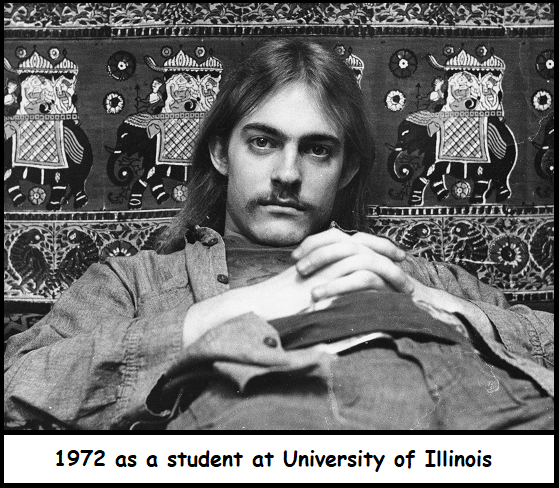 I graduated from Homewood-Flossmoor high school in Flossmoor, Illinois in 1970,
being distinguished as a National Merit Scholar finalist. Although I had exceptional
ACT and SAT scores and applied to Cornell and Stanford, I was only accepted by the University
of Illinois at Urbana-Champaign (UIUC), so off I went. Going off on one's own to college is always
a learning experience, in more ways than just scholarly studies. This was the era of the Vietnam
war, free love, experimentation with mind-altering drugs, and social unrest,
so my education was multifaceted. I was accepted into an
honors-track biology curriculum and did well; as it turned out, the breadth of classes that
I took for that curriculum actually covered enough subjects that by attending summer classes
for two years, I could qualify for two Bachelor's degrees. Thus, in 1974, I graduated with a
Bachelor of Arts in Mathematics
with a minor in Economics, as well as a
Bachelor of Science in Physiology
with a minor in Biochemistry, Cum Laude.
I graduated from Homewood-Flossmoor high school in Flossmoor, Illinois in 1970,
being distinguished as a National Merit Scholar finalist. Although I had exceptional
ACT and SAT scores and applied to Cornell and Stanford, I was only accepted by the University
of Illinois at Urbana-Champaign (UIUC), so off I went. Going off on one's own to college is always
a learning experience, in more ways than just scholarly studies. This was the era of the Vietnam
war, free love, experimentation with mind-altering drugs, and social unrest,
so my education was multifaceted. I was accepted into an
honors-track biology curriculum and did well; as it turned out, the breadth of classes that
I took for that curriculum actually covered enough subjects that by attending summer classes
for two years, I could qualify for two Bachelor's degrees. Thus, in 1974, I graduated with a
Bachelor of Arts in Mathematics
with a minor in Economics, as well as a
Bachelor of Science in Physiology
with a minor in Biochemistry, Cum Laude.
Having developed an interest in how the brain works to engender consciousness and the implications that mind-altering substances have on understanding that process, I worked to graduate with honors under the supervision of C. Ladd Prosser, a renowned Comparative Physiologist whose textbook is still used to this day. I submitted my Honors Thesis entitled "Hallucinogenic Drugs and Central Neural Systems: Biochemistry and Neurophysiology", thus graduating with honors. I wanted to pursue graduate studies of how the brain worked, so I took the Graduate Record Examination (GRE) and applied for a National Science Foundation (NSF) fellowship. Fortunately my GRE scores were quite good, and I secured the NSF fellowship. I applied for neuroscience graduate programs at Johns Hopkins, Stanford, and the University of California at San Diego (UCSD). Unlike my undergraduate attempts, this time I was accepted by all three! Since my interest in the work of Steven Hillyard had been piqued by Emanuel Donchin while taking his class in Physiological Psychology at UIUC, combined with my desire to return to California, I enrolled in the graduate Neuroscience program at UCSD.
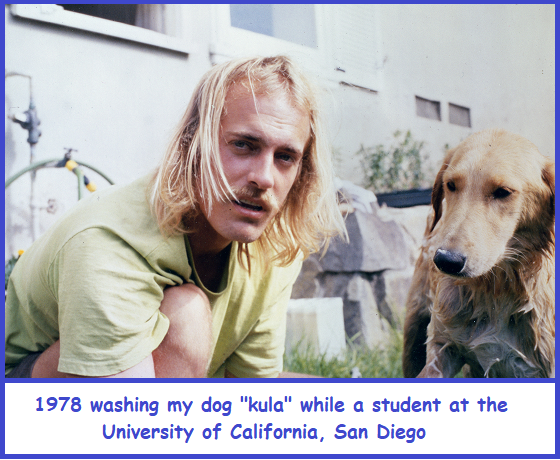 As new graduate students at UCSD rotate through five laboratories to help solidify their
interests and talents, so did I. One of these five laboratories was, of course, that of
Robert Galambos
and Steven Hillyard. This was the laboratory that I was most interested in and I
settled there.
As new graduate students at UCSD rotate through five laboratories to help solidify their
interests and talents, so did I. One of these five laboratories was, of course, that of
Robert Galambos
and Steven Hillyard. This was the laboratory that I was most interested in and I
settled there.
Robert Galambos was well respected for his early work with Don Griffin that elucidated the mechanism of echolocation in bats, whereby they employ ultrasonic sound to sense prey and navigate in their environment. This finding was initially met with disbelief, but by recording from neurons in the auditory system of the bats, Dr Galambos was able to demonstrate its veracity.
Dr. Hillyard's research focused on trying to identify and distinguish between various hypotheses of selective attention and other human cognitive processes by using signs present in human electroencephalographic (EEG) recordings, colloquially known as "brain waves". By using signal averaging techniques to compute Event-Related Potentials (ERPs), it was possible to detect changes in neural activity associated with selective attention to auditory stimuli in humans. This formed the subject of my thesis work.
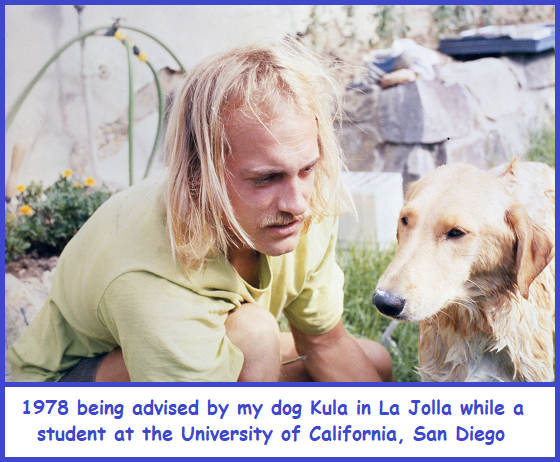 Graduate study
usually entails learning not only about the current state of research in a particular
specialty, but also how to properly perform research and understand what can be inferred from
experimental results. Hence, I was trained in electrophysiology, neurophysiology, experimental design,
statistics, and most especially the technical aspects of that research. I finally graduated
with a
PhD in Neuroscience
in 1981 after submitting my thesis entitled "Electrophysiological
Correlates of Selective Auditory Attention in Man."
Graduate study
usually entails learning not only about the current state of research in a particular
specialty, but also how to properly perform research and understand what can be inferred from
experimental results. Hence, I was trained in electrophysiology, neurophysiology, experimental design,
statistics, and most especially the technical aspects of that research. I finally graduated
with a
PhD in Neuroscience
in 1981 after submitting my thesis entitled "Electrophysiological
Correlates of Selective Auditory Attention in Man."
I continued on in this laboratory as a post-doc and technical support specialist for some time, accruing a modest set of publications, as listed in my Curriculum Vitae (CV). Eventually I became disillusioned by the politics and competition involved in nitty-gritty academic science, and took a early retirement. This is when all the unbelievable goings-on began that form the content of this web site...